I started keeping track of my mileage on mycyclinglog.com since late August, 2007. In 2008, I exceeded my mileage every month over 2007. Total mileage for the year was 6,562. Of this, 4,711 were "utility miles," meaning they displaced miles I would otherwise have driven. This translates into 2.43 tons of CO2 saved by not driving my Ford pickup truck. I would have also saved money, if I didn't spend it on bike parts I didn't need, instead. Results for all the bicycle commuters in our group are summarized at http://rideitlikeyoustoleit.us.
The big news, looking forward, is that the 100/200 is a definite GO for June 21, 2009. I typed up an information sheet and posted it to http://stevebarner.com. It's sure to be a great ride.
Friday, January 02, 2009

Saturday, December 20, 2008
Snow Biking
It's been 11 months, so it's high time to update the blog. I've managed to exceed my mileage every month this year over last. I've logged over 300 miles in December, alone. Yesterday should be counted as a mistake, though.
It started when I neglected to check the weather online before leaving home. I had an early meeting and I'd had a late meeting the day before, so I was feeling tight on time. The last weather report I had heard indicated the snow would start in the evening, so I rode the Bianchi road bike that is fitted with 700x32 Nokian A10 studded tires. These tires are ok on the road and have just enough studs to provide a grip on ice patches, but they are not so good in deep snow.
It was cold in the morning. The thermometer said 21 degrees, but it's been reading quite high. I need to move the sending unit location. I made it through the few inches of snow on the dirt road, though not without some excitement on a few rutted sections. There was a little light snow on the side of the road, but it wasn't bad when I had to go into it when cars were over taking me. The thermometer in Williston read 11 degrees, which seemed a lot more accurate.
It started snowing in earnest in the afternoon. I left shortly after 4:00, and traffic was heavy with people heading home for the weekend, trying to beat the storm. I stuck to the rec path all the way to Kimball Ave. There wasn't a lot of traffic heading out, but it wasn't easy riding, especially when I had to pull out of the travel lane. Traffic was really backed up and I couldn't ride to the right of the long line of cars, as the snow was just too deep and loose. I tried, but I was going all over the place, which just wasn't safe with all the cars around. I jogged with the bike to Williston Rd., tried riding it again, gave up, and walked the mile all the way to Tafts Corners. The thermometer read 8 degrees.
I tried riding again, but it was still pretty tough. I let out much of the air in the tires, and that helped a little, but I was very happy that a snow plow came along and cleared the road all the way across the shoulder. Things went better after that, all the way through Williston to the top of French Hill. There, things started to get interesting again. I waited for a line of cars to go by and then followed a panel truck down the hill. Soon, I realized that there was a limit to how much I could get on the brakes, as, even with the crummy brake pads on the bike, I was starting to slide the rear tire. The problem was, even though I wasn't going very fast, I was catching up to the panel truck! That, combined with the fact that it was dark, my glasses were icing and I couldn't really see where I was going, made that descent quite interesting. I stopped at the bottom and called Jeanne, telling her that I wasn't having fun anymore and she headed out to get me. I only made it to the edge of Richmond, a little over two miles farther, before meeting up with her.
I've ridden in the snow before, but hadn't had this much trouble. Of course, everything depends on the conditions, but it doesn't take a genius to figure out that biking during snow storms should be avoided, if possible. Heck, driving in snow storms should be avoided. I'm pretty sure I would have been much better off with the Fat Chance, which is sporting wider, knobby Nokians with more studs. The more rugged tires, combined with the upright position of the mountain bike, would have improved traction and low speed maneuverability. If I had seen the weather I would probably still have ridden, but with the other bike. If it had happened again today, I would have driven my truck!
Bottom line: The Nokian A10s are great for clear, sub-zero riding--well, they're probably one of the best alternatives, anyway. It's hard to say that any snow tire is "great." But if you are going to have only one set of snows on your bike, and if you plan to ride in all types of weather, get a more aggressive tire, at least if you live in snow country, like northern Vermont.
It started when I neglected to check the weather online before leaving home. I had an early meeting and I'd had a late meeting the day before, so I was feeling tight on time. The last weather report I had heard indicated the snow would start in the evening, so I rode the Bianchi road bike that is fitted with 700x32 Nokian A10 studded tires. These tires are ok on the road and have just enough studs to provide a grip on ice patches, but they are not so good in deep snow.
It was cold in the morning. The thermometer said 21 degrees, but it's been reading quite high. I need to move the sending unit location. I made it through the few inches of snow on the dirt road, though not without some excitement on a few rutted sections. There was a little light snow on the side of the road, but it wasn't bad when I had to go into it when cars were over taking me. The thermometer in Williston read 11 degrees, which seemed a lot more accurate.
It started snowing in earnest in the afternoon. I left shortly after 4:00, and traffic was heavy with people heading home for the weekend, trying to beat the storm. I stuck to the rec path all the way to Kimball Ave. There wasn't a lot of traffic heading out, but it wasn't easy riding, especially when I had to pull out of the travel lane. Traffic was really backed up and I couldn't ride to the right of the long line of cars, as the snow was just too deep and loose. I tried, but I was going all over the place, which just wasn't safe with all the cars around. I jogged with the bike to Williston Rd., tried riding it again, gave up, and walked the mile all the way to Tafts Corners. The thermometer read 8 degrees.
I tried riding again, but it was still pretty tough. I let out much of the air in the tires, and that helped a little, but I was very happy that a snow plow came along and cleared the road all the way across the shoulder. Things went better after that, all the way through Williston to the top of French Hill. There, things started to get interesting again. I waited for a line of cars to go by and then followed a panel truck down the hill. Soon, I realized that there was a limit to how much I could get on the brakes, as, even with the crummy brake pads on the bike, I was starting to slide the rear tire. The problem was, even though I wasn't going very fast, I was catching up to the panel truck! That, combined with the fact that it was dark, my glasses were icing and I couldn't really see where I was going, made that descent quite interesting. I stopped at the bottom and called Jeanne, telling her that I wasn't having fun anymore and she headed out to get me. I only made it to the edge of Richmond, a little over two miles farther, before meeting up with her.
I've ridden in the snow before, but hadn't had this much trouble. Of course, everything depends on the conditions, but it doesn't take a genius to figure out that biking during snow storms should be avoided, if possible. Heck, driving in snow storms should be avoided. I'm pretty sure I would have been much better off with the Fat Chance, which is sporting wider, knobby Nokians with more studs. The more rugged tires, combined with the upright position of the mountain bike, would have improved traction and low speed maneuverability. If I had seen the weather I would probably still have ridden, but with the other bike. If it had happened again today, I would have driven my truck!
Bottom line: The Nokian A10s are great for clear, sub-zero riding--well, they're probably one of the best alternatives, anyway. It's hard to say that any snow tire is "great." But if you are going to have only one set of snows on your bike, and if you plan to ride in all types of weather, get a more aggressive tire, at least if you live in snow country, like northern Vermont.
Saturday, January 19, 2008
Half-way through January with way-more miles than December
After riding back and forth to work (19 miles each way) for four days in a row, I was really beat. I started with my Fat Chance mountain bike (no longer considered a mountain bike according to the younger set, because it lacks any type of suspension). After slogging through mud with the consistency of mashed potatoes, due to the January thaw, I was happy to see the temperature drop below freezing. The Fat Chance has studded Nokian tires in the winter and these things claw out of pretty much anything winter throws in the way, but riding such a long commute sure takes a toll out of my energy reserves. It's amazing how quickly a cyclist can lose that warm-weather muscle tone in the off-season.
I wanted to speed up the commute, so I sprung for a pair of Nokian A10 35 x 700C studded tires. These tires have only 70 or so studs, while the tires I have on the Fat Chance have more than 100. Really aggressive studded tires often have over 300 studs. Still, the A10s have their studs located close to the outside edges and they are staggered. This puts them where you really need them, helping you to climb out of frozen ruts. I came up the hill on my dirt road on knobby tires without studs on my fourth day of riding and fell twice when I got caught in ruts--not something that typically happens to me. I was going quite slow climbing the hill and nothing got hurt or damaged. Riding up the same hill, with the same ruts, on the same bike, but now with the Nokians, I didn't even come close to going over.
The Nokians are still pretty heavy, but they are a lot easier to ride than the more aggressive ones I have on the Fat Chance. I highly recommend them to anyone who is doing winter riding and wants the advantages of studs with the lowest cost in performance. Winter conditions can put treacherous ice in your path without warning. As far as I'm concerned, studded tires are an absolute necessity for winter riding an cold. snowy climates
like Vermont.
I got my Nokians from Peter White Cycles. Peter ships very fast, has many models in stock and offers good prices. Unless you think there is a very good possibility that you will not be putting many miles on them, don't waste your money on tires with steel studs. Pay the money and get carbide studs. You won't regret it. If you live near Burlington, the Old Spokes Home has studded tires in stock. These guys ride their bikes year-round and can give you good advice.
I wanted to speed up the commute, so I sprung for a pair of Nokian A10 35 x 700C studded tires. These tires have only 70 or so studs, while the tires I have on the Fat Chance have more than 100. Really aggressive studded tires often have over 300 studs. Still, the A10s have their studs located close to the outside edges and they are staggered. This puts them where you really need them, helping you to climb out of frozen ruts. I came up the hill on my dirt road on knobby tires without studs on my fourth day of riding and fell twice when I got caught in ruts--not something that typically happens to me. I was going quite slow climbing the hill and nothing got hurt or damaged. Riding up the same hill, with the same ruts, on the same bike, but now with the Nokians, I didn't even come close to going over.
The Nokians are still pretty heavy, but they are a lot easier to ride than the more aggressive ones I have on the Fat Chance. I highly recommend them to anyone who is doing winter riding and wants the advantages of studs with the lowest cost in performance. Winter conditions can put treacherous ice in your path without warning. As far as I'm concerned, studded tires are an absolute necessity for winter riding an cold. snowy climates
like Vermont.
I got my Nokians from Peter White Cycles. Peter ships very fast, has many models in stock and offers good prices. Unless you think there is a very good possibility that you will not be putting many miles on them, don't waste your money on tires with steel studs. Pay the money and get carbide studs. You won't regret it. If you live near Burlington, the Old Spokes Home has studded tires in stock. These guys ride their bikes year-round and can give you good advice.
Monday, December 24, 2007
Appalachian Gap: It's 12 for 12!

The last climb. I shot this on the way back down--no dabs!
In spite of a nagging cold, I got out Saturday afternoon for the December climb up App Gap, meeting my goal of climbing the Gap at least once a month for a year. Last year, I hit every month except December. This year, I did the climb as many as three times in a month, but not a month went by when I didn't make the climb at least once.
Conditions were ok, with temperatures in the mid-30s. The climb could have been done on a road bike without studded tires, but one would have to have ridden back down the last hundred yards or so from the summit in the climbing lane, carefully picking a clear line. It would have been a challenge if you had to compete with cars coming up. It was very nice having studded tires, as I could pull over to let cars pass without worrying about the snow and ice I needed to ride over.

The view from the top
One of the neatest things was the number of people who gave me the thumbs-up on the climb. I suspect most people coming over the mountain were coming back from a great day skiing at Sugarbush or Mad River Glen, and skiers understand this kind of challenge better than the average person, but one guy actually rolled down his window and leaned out to shout encouragement as we passed on one of the upper switchbacks.
I rode my 1983 Fat Chance mountain bike, outfitted with Nokian studded tires. These are the style designed primarily for plowed dirt and paved roads, with a little over 100 studs in two rows. I have found this to be a good compromise between traction and rolling resistance and, while there are times when I've wished I had more studs, I've never lost traction with these. I'm not at all keen on doing long rides with mountain bars in an off-road riding position, so I'd like to experiment with studded road tires on a road bike for winter riding. There are some interesting designs available.

Approaching App Gap
My advice for anyone getting stated with studded tires is to be sure you get good tires with carbide studs. The cheaper tires with steel studs just are not worth it, especially with as many strikes against you as you already have with winter cycling. You can always turn around and sell your tires if you decide winter riding is not for you. If you are in northern Vermont, you can get these tires at a good price at the Old Spokes Home in Burlington. Otherwise, you can get them by mail from Peter White, who probably sells more of these tires than anyone else in the country.
Will I try to repeat this goal of a Gap a month? At this point, I'm not sure. I know a guy who lives a little closer to the Gap who does it at least once a week during riding season to prepare for the Green Mountain Stage Race, and Chris Bohjalian rides Lincoln Gap two or three times a week when it isn't covered with snow. I'm far from earning any unique bragging rights for continuing to ride the Gap every month. I was thinking when I started the December ride that I would rather be getting in more miles on a road bike, since this would have been possible if I had stuck to the lowlands, though it was fun to be at the top of the Gap, and the ride back, downhill and with a tailwind, made the slogging climb worthwhile. Perhaps I'll broaden my scope a little, or tackle a real challenge, like doing a century ride every month. That would be a tough thing to accomplish in northern Vermont! I will say, though, that it's fun to have a goal, no matter how arbitrary, and it's rewarding to meet it.
Friday, August 17, 2007
L.A.M.B. Ride--I made it!
The L.A.M.B. ride traverses four of Vermont's "gaps," which are mountain passes that cross the spine of the Green Mountains, from east to west. The Green Mountains are part of the Appalachian Mountain chain and were scoured by glaciers thousands of years ago, leaving river valleys running north and south, paralleling the mountain ridges. The gaps are located at locations where the spine of the mountains drops low enough to get a road over it, if barely. The L.A.M.B. ride tackles four of these gaps; Lincoln, Appalachian, Middlebury and Brandon.
As organized annually by the Killington-Pico Cycling Club, the L.A.M.B. ride starts in Rochester, which is convenient to people traveling up from the south, and rides north up Rte 100 through Granville Gulf to tackle the worse climb, Lincoln Gap, first. Lincoln Gap starts out paved, turns to smooth dirt for a few miles, then is paved again for the last three miles or so of steep stuff. This stretch is said to include the steepest mile of paved road in the continental US, and I believe it. While there several places where the climb eases up a little, climbing Lincoln is a real grunt-fest. Like a mountain biker, you need to pay close attention to body location, so you can keep the front wheel on the ground while maintaining traction. I had converted my classic steel Marinoni to a triple chainring, using a TA tripleizer chainring and added a 30-tooth inner ring. Combined with a 13-30 freewheel in the back, I had a 1:1 ratio, which is as close to walking as I ever get. That's virtually the same gearing I use on my mountain bike for steep off-road work and I was very glad that I had these granny gears on this ride.
I made it all the way up Lincoln Gap without stopping, which is a feat all by itself. Most other riders were using significantly taller gearing, but many of them had to stop and recover at least once on the climb. Once we regrouped, we picked our way down the other side. Lincoln Gap does not reward you with a nice, long descent at the top. It's quite treacherous getting down the dirt section and I had problems with a strap-on second waterbottle cage that kept moving around on the tube. Later in the ride, I got a piece of tape from helpful clerk and placed this around the tube under the strap and this solved the annoying problem.
We stopped at the general store in Lincoln to regroup and discovered that the store keeps a presta floor pump in the window for cyclists who need to top off. How cool is that? We stayed at the store long enough for everyone to get back together and then headed down to Rte 116, where we skipped north to tackle Appalachian Gap. App Gap starts with a smaller climb, dubbed the Baby Gap, then actually drops a few hundred feet before the steep final climb. Whereas Lincoln Gap approaches 25% grade, App Gap is a bit tamer with the final steepest section being around 19%. GMBC riders do App Gap regularly in training for the Green Mountain Stage Race, which has two stages that include it. I'm on track thus far in climbing App Gap at least once each month this year.
We zoomed down the east side of App Gap (and I do mean zoomed) and picked up just the lightest sprinkles, not enough to really get wet. The weather turned out great and we never got soaked, in spite of the projected 70% chance of rain. We stayed a long time at the stop outside Waitsfield. It turned out that one of the riders had flatted so badly that he had to hitch a ride down the gap with a motorist. Luckily, there was a bike shop right there where he could purchase a replacement tire. One year, a L.A.M.B. rider trashed a wheel and this shop loaned him a very nice road bike to finish the ride at no charge. Now that's service!
We then headed south, back through Granville Gulf, to pick up Middlebury Gap. A little over half the riders chose to end the ride here after the break and continue the few miles south to Rochester. This actually has a cute name; the LAMB-chop. Seven of us decided to tackle the last two climbs. Middlebury Gap is one of those climbs where you hear comments like "This isn't so bad" about half-way up from people who haven't ridden it before. It never gets terribly steep, it just grinds on and on. Those comments always stop well before the summit. There is a nice, long descent on the other side through Ripton before we turned off onto a smooth dirt road that turned back to pavement after a few miles, taking us around the east side of Lake Dunsmore. Another stop at very nice little general store with great prices for a change and then we headed up Brandon Gap. Brandon is, perhaps, the easiest of the four gaps, but anything is a grind after that much climbing. I just stayed in that granny gear and ended up crossing the summit alongside another rider, making us the last two riders in the group. Brandon Gap is much steeper on the west side than the east, and the gradual descent took us all the way into Rochester, which was about 10 miles.
I was very glad to have completed this ride, especially since I had tried it three years ago and had to bail with the rest of the LAMB-choppers. I do wonder, though, about the folks who do the six-gap ride much earlier in the season, adding in Roxbury and Rochester gaps. You can read about their exploits at http://www.northeastcycling.com/six_gaps.html. And then there's the gap rides down in Georgia, but I dan't know how these compare. Both the L.A.M.B. and the Georgia six-gap rides boast around 10,000' of climbing in about 100 miles, so I presume the Vermont six-gap climb is even more challenging. Maybe next year...
I posted ride photos at http://picasaweb.google.com/sbarner/2007LAMBRide. Enjoy!
As organized annually by the Killington-Pico Cycling Club, the L.A.M.B. ride starts in Rochester, which is convenient to people traveling up from the south, and rides north up Rte 100 through Granville Gulf to tackle the worse climb, Lincoln Gap, first. Lincoln Gap starts out paved, turns to smooth dirt for a few miles, then is paved again for the last three miles or so of steep stuff. This stretch is said to include the steepest mile of paved road in the continental US, and I believe it. While there several places where the climb eases up a little, climbing Lincoln is a real grunt-fest. Like a mountain biker, you need to pay close attention to body location, so you can keep the front wheel on the ground while maintaining traction. I had converted my classic steel Marinoni to a triple chainring, using a TA tripleizer chainring and added a 30-tooth inner ring. Combined with a 13-30 freewheel in the back, I had a 1:1 ratio, which is as close to walking as I ever get. That's virtually the same gearing I use on my mountain bike for steep off-road work and I was very glad that I had these granny gears on this ride.
I made it all the way up Lincoln Gap without stopping, which is a feat all by itself. Most other riders were using significantly taller gearing, but many of them had to stop and recover at least once on the climb. Once we regrouped, we picked our way down the other side. Lincoln Gap does not reward you with a nice, long descent at the top. It's quite treacherous getting down the dirt section and I had problems with a strap-on second waterbottle cage that kept moving around on the tube. Later in the ride, I got a piece of tape from helpful clerk and placed this around the tube under the strap and this solved the annoying problem.
We stopped at the general store in Lincoln to regroup and discovered that the store keeps a presta floor pump in the window for cyclists who need to top off. How cool is that? We stayed at the store long enough for everyone to get back together and then headed down to Rte 116, where we skipped north to tackle Appalachian Gap. App Gap starts with a smaller climb, dubbed the Baby Gap, then actually drops a few hundred feet before the steep final climb. Whereas Lincoln Gap approaches 25% grade, App Gap is a bit tamer with the final steepest section being around 19%. GMBC riders do App Gap regularly in training for the Green Mountain Stage Race, which has two stages that include it. I'm on track thus far in climbing App Gap at least once each month this year.
We zoomed down the east side of App Gap (and I do mean zoomed) and picked up just the lightest sprinkles, not enough to really get wet. The weather turned out great and we never got soaked, in spite of the projected 70% chance of rain. We stayed a long time at the stop outside Waitsfield. It turned out that one of the riders had flatted so badly that he had to hitch a ride down the gap with a motorist. Luckily, there was a bike shop right there where he could purchase a replacement tire. One year, a L.A.M.B. rider trashed a wheel and this shop loaned him a very nice road bike to finish the ride at no charge. Now that's service!
We then headed south, back through Granville Gulf, to pick up Middlebury Gap. A little over half the riders chose to end the ride here after the break and continue the few miles south to Rochester. This actually has a cute name; the LAMB-chop. Seven of us decided to tackle the last two climbs. Middlebury Gap is one of those climbs where you hear comments like "This isn't so bad" about half-way up from people who haven't ridden it before. It never gets terribly steep, it just grinds on and on. Those comments always stop well before the summit. There is a nice, long descent on the other side through Ripton before we turned off onto a smooth dirt road that turned back to pavement after a few miles, taking us around the east side of Lake Dunsmore. Another stop at very nice little general store with great prices for a change and then we headed up Brandon Gap. Brandon is, perhaps, the easiest of the four gaps, but anything is a grind after that much climbing. I just stayed in that granny gear and ended up crossing the summit alongside another rider, making us the last two riders in the group. Brandon Gap is much steeper on the west side than the east, and the gradual descent took us all the way into Rochester, which was about 10 miles.
I was very glad to have completed this ride, especially since I had tried it three years ago and had to bail with the rest of the LAMB-choppers. I do wonder, though, about the folks who do the six-gap ride much earlier in the season, adding in Roxbury and Rochester gaps. You can read about their exploits at http://www.northeastcycling.com/six_gaps.html. And then there's the gap rides down in Georgia, but I dan't know how these compare. Both the L.A.M.B. and the Georgia six-gap rides boast around 10,000' of climbing in about 100 miles, so I presume the Vermont six-gap climb is even more challenging. Maybe next year...
I posted ride photos at http://picasaweb.google.com/sbarner/2007LAMBRide. Enjoy!
Monday, June 25, 2007
Another successful 100/200 Ride

June 23rd saw another successful 100/200, doing a solo again, with the able and necessary support of my wife, Jeanne. It was an excellent run, the best one ever! I rode a new bike this time, a Klein Q-Pro frame outfitted with Campagnolo Chorus 8-spd componentry. My trusty Marinoni, which has been my steed for every one of the previous seven 100/200s, was fitted with a triple and went along for the ride, perched loftily on the car's roof rack, but it was only symbolic. I never needed a gear lower than the 39x26 I had on the Klein.
Ride details may be found at http://stevebarner.com.
Sunday, April 01, 2007
Doin' the Gap, again!

Here's the view from the top of Appalachian Gap, Saturday, March 31. As you can see, the snow and ice are receding and this has brought out flocks of early-season cyclists here in northern Vermont. The weather was cool, in the low 40s, and there was a light north wind, but the bright sun made things feel warmer. The temperature at the top of the Gap was probably in the low 30s, but the roads were clear. Cycling season has officially started! (I know, because this was may first ride this year without fenders.) I got two Gap rides in during March, maybe three--I lost count.
Wednesday, February 28, 2007
Appalachian Gap, 2-0
Last year, I had an informal goal to climb the Appalachian Gap at least once a month throughout the year. I might have pulled it off, but I missed December. I really could have made it happen, but I let the two opportunities that month slip by for various reasons. I am now 2 and 0 this year, having slid in the February ride on the 28th. The strong sun and temperatures hovering just below freezing in the afternoon invited me out. The roads were generally clear, since we have not had any snow for a few days and the skies have been clear. The snowbanks are right up to the edge of the road, but the pavement itself is pretty clear. The tricky spots are in the shade and where enough melting snow has flowed across the road to wash away the road salt. Water freezes quicker and slicker here than where the salt keeps it slushy for a few degrees below freezing. Here's a link to a RouteSlip map of the ride.
 The Gap climb was the trickiest, as far as frozen stuff was concerned. There were several places that I marked on the way up to be especially careful of coming back down. There was more traffic than usual, with skiers coming back from the resorts on the other side. The road crews dump a lot of sand and salt on the Gap, as it is kept open throughout the winter. This junk tends to accumulate in the center and on the shoulder, forcing you out into the traffic lane. Cars are not usually going fast enough for this to be a real problem, but when they drift over to pass you, they get into the center and throw up a nasty cloud of fine dust.
There are several important factors to consider in winter riding. Most important is the weather and road conditions, as both can change in a very short time. Online weather services like WeatherUnderground are a real help here. If there is any chance of running into sections of snow or ice, you MUST have studded tires. Don't cheap out here. Get the best carbide-studded tires you can. I have a set of Nokian studded tires on my snow bike (an '84 Fat Chance mountain bike). These tires have about 110 studs per tire in two rows and there are times when I would gladly give up a little energy for more studs. You are already farther out in the road with no place to go. Go down on unseen broken pavement under slimy snow in front of overtaking cars and your riding days might be over. You want every advantage. The problem is that studded tires are higher profile and most road and even hybrid bikes lack the clearance for them and the absolutely necessary fenders.
 Eventually, I'm going to build a frame with clearance for 700C studded tires, but for now I'll stick with the Fat Chance for commuting in snow and the Bianchi Axis (Volpe) with knobby cyclocross tires and the Atala for salty, muddy, but clear roads. The Atala is what I rode up the Gap yesterday. It's a low-end model that rides surprisingly well and which I've turned into a lousy-conditions road bike. All three of these bikes have been offered as sacrifices to the salt gods, and that's the second consideration of winter riding; you don't want to use a bike that you want to keep looking good, because it's just not going to happen. Salt will destroy your bike no matter how careful you are to clean it after every ride. It is much better to have a bike that you dedicate to this purpose, so you don't spend the summer looking down at an ugly, corroded bike.
Finally, you need to pay attention to clothing. Anything cotton is out. You need several layers, and don't be afraid to stop and take a layer off when you get too warm. Bring something extra to put on if necessary; a rack-top pack or pannier works well to stash extra items. The temperature at the top of the Gap was around 20 degrees F, a critical ten degrees colder than at the start. With a long descent on which to cool down, it got pretty chilly. I picked up a headwind on the way back, making things even worse. I wished I had packed an extra shell and some ear warmers. It was all worth it, though. Don't let the cold weather keep you indoors!
 The Gap climb was the trickiest, as far as frozen stuff was concerned. There were several places that I marked on the way up to be especially careful of coming back down. There was more traffic than usual, with skiers coming back from the resorts on the other side. The road crews dump a lot of sand and salt on the Gap, as it is kept open throughout the winter. This junk tends to accumulate in the center and on the shoulder, forcing you out into the traffic lane. Cars are not usually going fast enough for this to be a real problem, but when they drift over to pass you, they get into the center and throw up a nasty cloud of fine dust.
There are several important factors to consider in winter riding. Most important is the weather and road conditions, as both can change in a very short time. Online weather services like WeatherUnderground are a real help here. If there is any chance of running into sections of snow or ice, you MUST have studded tires. Don't cheap out here. Get the best carbide-studded tires you can. I have a set of Nokian studded tires on my snow bike (an '84 Fat Chance mountain bike). These tires have about 110 studs per tire in two rows and there are times when I would gladly give up a little energy for more studs. You are already farther out in the road with no place to go. Go down on unseen broken pavement under slimy snow in front of overtaking cars and your riding days might be over. You want every advantage. The problem is that studded tires are higher profile and most road and even hybrid bikes lack the clearance for them and the absolutely necessary fenders.
 Eventually, I'm going to build a frame with clearance for 700C studded tires, but for now I'll stick with the Fat Chance for commuting in snow and the Bianchi Axis (Volpe) with knobby cyclocross tires and the Atala for salty, muddy, but clear roads. The Atala is what I rode up the Gap yesterday. It's a low-end model that rides surprisingly well and which I've turned into a lousy-conditions road bike. All three of these bikes have been offered as sacrifices to the salt gods, and that's the second consideration of winter riding; you don't want to use a bike that you want to keep looking good, because it's just not going to happen. Salt will destroy your bike no matter how careful you are to clean it after every ride. It is much better to have a bike that you dedicate to this purpose, so you don't spend the summer looking down at an ugly, corroded bike.
Finally, you need to pay attention to clothing. Anything cotton is out. You need several layers, and don't be afraid to stop and take a layer off when you get too warm. Bring something extra to put on if necessary; a rack-top pack or pannier works well to stash extra items. The temperature at the top of the Gap was around 20 degrees F, a critical ten degrees colder than at the start. With a long descent on which to cool down, it got pretty chilly. I picked up a headwind on the way back, making things even worse. I wished I had packed an extra shell and some ear warmers. It was all worth it, though. Don't let the cold weather keep you indoors!
Saturday, January 27, 2007
I Discovered Online Route Maps
Well, I almost made my goal of riding Appalachian Gap every month of 2006, but then missed out on December. There was at least one day that I had available when I could have ridden it, but it didn't happen. So, there were two goals I missed in 2006, the monthly gap ride and the SLAM. I knocked off January's Gap ride early in the month, on a day that was so warm I wore short-fingered riding gloves. I rode at least seven 40-mile rides in the first two weeks of January, but haven't been on the bike since then as the temperature dropped precipitously. It's -10 degrees now.
The really exciting thing for me was that I discovered online route maps. I've been trying out Bikely.com, VeloRoutes.org and RouteSlip.com. Bikely.com is easy to use and quick. It also seems to be the most versatile, with the ability to add and change points after the route is saved. I couldn't get their elevation feature to work, but I think that's just a temporary glitch. RouteSlip.com is very interesting, especially since they have a training log and other interesting features. I had problems saving some of my routes, though, which was a bit frustrating since they took a while to input. Their elevation feature didn't work right either.
VeloRoutes.org looked interesting, but the interface was so terribly slow that I gave up on it for now. I just tried it again and things seem to be much quicker now. This service is very interesting in that it ties icons on the map to photos, comments about things such as steep climbs, and even webcams to the map. You can click on one of these icons and brink up a popup that displays the feature. A city like Seattle is peppered with webcams. Vermont has a few public webcams, but I didn't see any on VeloRoutes. I especially liked the radar feature that overlays radar weather conditions on the current map. I did have to chuckle about the things people call "monster climbs" in Seattle. If 130' is a monster climb, what is the 800' climb on my daily commute getting home up my dirt road?
These services are definitely worth checking out. They will provide us with some really neat tools to share rides with others. According to its creator, veloroutes runs on a computer in his apartment, so there may be some serious longevity and scalability questions to consider before sinking a lot of time into inputting rides. Still, he's to be commended for his efforts and perhaps he'll find a way to make it profitable enough to spin off into an enterprise.
The really exciting thing for me was that I discovered online route maps. I've been trying out Bikely.com, VeloRoutes.org and RouteSlip.com. Bikely.com is easy to use and quick. It also seems to be the most versatile, with the ability to add and change points after the route is saved. I couldn't get their elevation feature to work, but I think that's just a temporary glitch. RouteSlip.com is very interesting, especially since they have a training log and other interesting features. I had problems saving some of my routes, though, which was a bit frustrating since they took a while to input. Their elevation feature didn't work right either.
VeloRoutes.org looked interesting, but the interface was so terribly slow that I gave up on it for now. I just tried it again and things seem to be much quicker now. This service is very interesting in that it ties icons on the map to photos, comments about things such as steep climbs, and even webcams to the map. You can click on one of these icons and brink up a popup that displays the feature. A city like Seattle is peppered with webcams. Vermont has a few public webcams, but I didn't see any on VeloRoutes. I especially liked the radar feature that overlays radar weather conditions on the current map. I did have to chuckle about the things people call "monster climbs" in Seattle. If 130' is a monster climb, what is the 800' climb on my daily commute getting home up my dirt road?
These services are definitely worth checking out. They will provide us with some really neat tools to share rides with others. According to its creator, veloroutes runs on a computer in his apartment, so there may be some serious longevity and scalability questions to consider before sinking a lot of time into inputting rides. Still, he's to be commended for his efforts and perhaps he'll find a way to make it profitable enough to spin off into an enterprise.
Saturday, November 25, 2006
Smugglers' Notch is closed for the winter!
It was as good as it gets in November in Vermont. The temp was in the upper 40s and not a cloud in the sky. I decided to try one more run at VT 108 over Smugglers' Notch before the snow flies, which is usually well before now. This is a 60-mile loop for me; I call it "riding around the block," as all I need to do is take a right turn onto every road that is paved all the way through. I pumped up the sewups on my '82 Richard Sachs, hung a spare tubular under the saddle and headed out just after lunch.
It was a beautiful ride. The route travels aptly-named Pleasant Valley Road, which is one of the best cycling roads anywhere, in my opinion. I noted the sign in Jeffersonville announcing that the Notch is closed for the winter, but hoped that the recent warm weather had left the road passable. I went around the barrier on clear, dry road but a half-mile from the summit the ice started to appear. It's cold up there and where the cliffs shade the road on the north side, there is nothing to melt the ice. The road crew doesn't plow or salt the road once you get pass the barrier at the ski area. At first it was little patches of ice that made the rear wheel break loose with a "VVVT-VVVT" sound. Then it was the precarious slide of the front wheel until it caught pavement again. When there weren't many dry patches left, I decided I should get my cleat out of the pedal. Just in time! the bike shot out from underneath me just as I had my foot free.
I didn't want to turn back, expecting that the south side would be clearer than the north and knowing I wasn't far from the top. It was amazingly slippery in my road shoes; I had to aim for the crunchy spots and the bike didn't want to stay upright at all, even without a rider. As I neared the top, I actually passed another roadie walking his bike the other way! We agreed that the Notch should be considered closed for the winter.
The descent was even trickier than usual. The ice disappeared quickly, but the switchbacks on the south side are covered with clods of dirt that has washed across the road. The annual closing of the road makes it a pedestrian haven. People walking in groups are likely to cross the road right in front of you, not expecting cyclists to come whizzing up from behind. Even more hazardous are the unleashed dogs, who bound up from the brush to rejoin their masters, coming up out of nowhere right in front of you. I had to brake hard three times to avoid these dogs. And then there is the occaisional jerk, always a male, who just has to prove that his 4-wheel drive can still make the road. I so want these dopes to slide into the ditch! How gripping a steering wheel and pushing a gas pedal is supposed to prove to the world that these guys are tough is absolutely beyond me. Read the sign, dope!
It's a minor goal of mine to be one of the last roadies over the Notch as winter sets in and to be one of the first over it in the spring. It's a great ride, and the northern approach should be within the ability of almost any fit cyclist. We even rode our tandem over it this past summer. Give it a try, sometime!
It was a beautiful ride. The route travels aptly-named Pleasant Valley Road, which is one of the best cycling roads anywhere, in my opinion. I noted the sign in Jeffersonville announcing that the Notch is closed for the winter, but hoped that the recent warm weather had left the road passable. I went around the barrier on clear, dry road but a half-mile from the summit the ice started to appear. It's cold up there and where the cliffs shade the road on the north side, there is nothing to melt the ice. The road crew doesn't plow or salt the road once you get pass the barrier at the ski area. At first it was little patches of ice that made the rear wheel break loose with a "VVVT-VVVT" sound. Then it was the precarious slide of the front wheel until it caught pavement again. When there weren't many dry patches left, I decided I should get my cleat out of the pedal. Just in time! the bike shot out from underneath me just as I had my foot free.
I didn't want to turn back, expecting that the south side would be clearer than the north and knowing I wasn't far from the top. It was amazingly slippery in my road shoes; I had to aim for the crunchy spots and the bike didn't want to stay upright at all, even without a rider. As I neared the top, I actually passed another roadie walking his bike the other way! We agreed that the Notch should be considered closed for the winter.
The descent was even trickier than usual. The ice disappeared quickly, but the switchbacks on the south side are covered with clods of dirt that has washed across the road. The annual closing of the road makes it a pedestrian haven. People walking in groups are likely to cross the road right in front of you, not expecting cyclists to come whizzing up from behind. Even more hazardous are the unleashed dogs, who bound up from the brush to rejoin their masters, coming up out of nowhere right in front of you. I had to brake hard three times to avoid these dogs. And then there is the occaisional jerk, always a male, who just has to prove that his 4-wheel drive can still make the road. I so want these dopes to slide into the ditch! How gripping a steering wheel and pushing a gas pedal is supposed to prove to the world that these guys are tough is absolutely beyond me. Read the sign, dope!
It's a minor goal of mine to be one of the last roadies over the Notch as winter sets in and to be one of the first over it in the spring. It's a great ride, and the northern approach should be within the ability of almost any fit cyclist. We even rode our tandem over it this past summer. Give it a try, sometime!
Terrible Mountain on a Track Bike
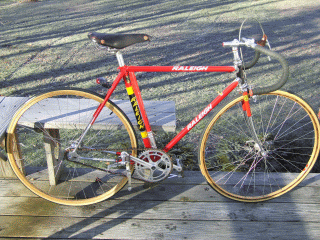
It was a Friday in early November and I was heading south on I89 on a beautiful day, heading for a full-day meeting in Boston. Hoping that I would have an hour or so of daylight after the meeting, I had tossed my trusty old Raleigh track bike into the back of the car. This bike has tons of stories of its own, but we won't go into them here. Suffice it to say that I have owned this bike since new and rode it enough to actually wear out a frame! Riding this bike taught me the value of a fixed gear bike for city riding; a realization that preceded the current fixation on fixies by decades. Since I would be in fairly flat Boston, I thought that the track bike was the perfect ride to bring along.

I had just crossed the Vermont- New Hampshire border when my cell phone rang. It was the organizer of the event telling me that it had been cancelled, due to a problem with the facility. Since I had already made arrangements for coverage for my classes and there was not time enough to get to school before half of them would be over, I decided to visit a couple of the schools that we support that are located on the east side of the state, instead.
I visited the instructors at Hartford Area Career & Technical Center in White River Junction and the River Valley Technical Center in Springfield, spending a couple of hours at each location. I wrapped up the visits around 1:00 and decided that there was time to get in a hilly loop, even if I didn't have the right bike for it. I drove to Chester and found a pull-off where I could park and change. I sped off on the track bike, hoping to get in about 50 miles before dark.
A track bike is not designed for road use, having a single, fixed gear (no coasting), short wheelbase and no brakes. I had long ago added a front brake and road tires. I also had installed wooden rims to help absorb some of the road shock and vibration that telegraphs through such a tight frame. The frame geometry of this bike is not extreme by today's standards but in the early 1970s, such a tight, 18 lb bike was considered a real screamer. The short wheelbase helps make up for the relatively high single gear ratio (48 x 16, in this case), but it can still be quite a grunt muscling up the really steep stuff.
With the declining daylight, I decided to cut off part of the ride by taking a "shortcut" through Andover. This is always risky when it's a road that you have not traveled before. Andover proved to be at the top of a significant climb, several miles long and steep enough to require an impressive switchback. The pavement was new and the road follows a classic Vermont mountain stream. Everything was fine until just after the switchback when I twisted my foot slightly and heard a SNAP and noticed one cleat was now sloppy in the pedal. I decided that it would be extremely difficult to get started again if I stopped, so I continued to the top of the climb where I stopped to discover that I had broken one of my cleats. Now, that's not such a surprise on a pair of 25-year old shoes with lots of miles, but it still can be a serious problem on a track bike, where good purchase on the pedals is critical. Going down descents means that you have to pedal at a very rapid pace, since you cannot coast or shift to a higher gear. Still, I didn't want to turn back, so I decided to take my chances and continue on the loop.
The descent down to Weston is quite steep, so I worked very hard, resisting the desire of the bike to rocket down the hill by pushing hard backwards on the pedals. You don't back pedal on a track bike like you would on a coaster brake. Instead, you apply backward pressure on the pedals in the same way that you apply forward pressure on a climb. The difference is that it's not as efficient, due to the position of the leg on the power stroke and you use a completely different set of muscles.
Half way down the slope I passed the only other rider I saw that day, who was riding a triple-zoot Trek up the hill. He sure gave me a funny look as I worked so hard pedaling down the hill! Once the slope eased up, I let the speed increase and concentrated on keeping up a high spin without letting the broken cleat slip out of the pedal.
I turned onto VT 100 at Weston and was happily spinning away the miles when I came to the intersection where 100 splits off from VT 155. It suddenly came to me where I was and that I would now have to go over Terrible Mountain before reaching Ludlow. I have strong memories of this climb, having done it many times from the other direction during the classic 100/200 double-century ride. Luckily, the climb from the south approach is shallower than from the north, though many times longer. As the second major climb of the ride, it took a lot of effort to muscle the fixed gear to the eventual summit; then it was another stand on the pedals and work the old Weinmann sidepull brake to control the speed on that nasty descent.
Once in Ludlow I clicked on my flasher, as the light was starting to fade and the traffic had picked up quite a bit. I spun up the pace as I passed VT 131, feeling very sorry that I would run out of light if I turned off on that incredibly beautiful road. If you ever get a chance, ride VT 131 from Ludlow through Cavendish. It is a gorgeous, gradual downhill that follows an incredible trout stream. It's pure joy on two wheels.
I had enough left in the tank to keep the RPMs up as I went over Proctorsville Gulf and down the other side. Once the road leveled off, it was only a few more miles to the pulloff where I had parked the car and I ended the ride just before the daylight started to fade.
The next day, I was stiff, but the second and third days I could hardly walk at all! As I said, the fixed gear uses a whole different set of muscles when going down hills and I had sure abused them. Moderation and training may be the key but still, I am glad to be able to say I've been over Terrible Mountain on a track bike!
I had just crossed the Vermont- New Hampshire border when my cell phone rang. It was the organizer of the event telling me that it had been cancelled, due to a problem with the facility. Since I had already made arrangements for coverage for my classes and there was not time enough to get to school before half of them would be over, I decided to visit a couple of the schools that we support that are located on the east side of the state, instead.
I visited the instructors at Hartford Area Career & Technical Center in White River Junction and the River Valley Technical Center in Springfield, spending a couple of hours at each location. I wrapped up the visits around 1:00 and decided that there was time to get in a hilly loop, even if I didn't have the right bike for it. I drove to Chester and found a pull-off where I could park and change. I sped off on the track bike, hoping to get in about 50 miles before dark.
A track bike is not designed for road use, having a single, fixed gear (no coasting), short wheelbase and no brakes. I had long ago added a front brake and road tires. I also had installed wooden rims to help absorb some of the road shock and vibration that telegraphs through such a tight frame. The frame geometry of this bike is not extreme by today's standards but in the early 1970s, such a tight, 18 lb bike was considered a real screamer. The short wheelbase helps make up for the relatively high single gear ratio (48 x 16, in this case), but it can still be quite a grunt muscling up the really steep stuff.
With the declining daylight, I decided to cut off part of the ride by taking a "shortcut" through Andover. This is always risky when it's a road that you have not traveled before. Andover proved to be at the top of a significant climb, several miles long and steep enough to require an impressive switchback. The pavement was new and the road follows a classic Vermont mountain stream. Everything was fine until just after the switchback when I twisted my foot slightly and heard a SNAP and noticed one cleat was now sloppy in the pedal. I decided that it would be extremely difficult to get started again if I stopped, so I continued to the top of the climb where I stopped to discover that I had broken one of my cleats. Now, that's not such a surprise on a pair of 25-year old shoes with lots of miles, but it still can be a serious problem on a track bike, where good purchase on the pedals is critical. Going down descents means that you have to pedal at a very rapid pace, since you cannot coast or shift to a higher gear. Still, I didn't want to turn back, so I decided to take my chances and continue on the loop.
The descent down to Weston is quite steep, so I worked very hard, resisting the desire of the bike to rocket down the hill by pushing hard backwards on the pedals. You don't back pedal on a track bike like you would on a coaster brake. Instead, you apply backward pressure on the pedals in the same way that you apply forward pressure on a climb. The difference is that it's not as efficient, due to the position of the leg on the power stroke and you use a completely different set of muscles.
Half way down the slope I passed the only other rider I saw that day, who was riding a triple-zoot Trek up the hill. He sure gave me a funny look as I worked so hard pedaling down the hill! Once the slope eased up, I let the speed increase and concentrated on keeping up a high spin without letting the broken cleat slip out of the pedal.
I turned onto VT 100 at Weston and was happily spinning away the miles when I came to the intersection where 100 splits off from VT 155. It suddenly came to me where I was and that I would now have to go over Terrible Mountain before reaching Ludlow. I have strong memories of this climb, having done it many times from the other direction during the classic 100/200 double-century ride. Luckily, the climb from the south approach is shallower than from the north, though many times longer. As the second major climb of the ride, it took a lot of effort to muscle the fixed gear to the eventual summit; then it was another stand on the pedals and work the old Weinmann sidepull brake to control the speed on that nasty descent.
Once in Ludlow I clicked on my flasher, as the light was starting to fade and the traffic had picked up quite a bit. I spun up the pace as I passed VT 131, feeling very sorry that I would run out of light if I turned off on that incredibly beautiful road. If you ever get a chance, ride VT 131 from Ludlow through Cavendish. It is a gorgeous, gradual downhill that follows an incredible trout stream. It's pure joy on two wheels.
I had enough left in the tank to keep the RPMs up as I went over Proctorsville Gulf and down the other side. Once the road leveled off, it was only a few more miles to the pulloff where I had parked the car and I ended the ride just before the daylight started to fade.
The next day, I was stiff, but the second and third days I could hardly walk at all! As I said, the fixed gear uses a whole different set of muscles when going down hills and I had sure abused them. Moderation and training may be the key but still, I am glad to be able to say I've been over Terrible Mountain on a track bike!
Friday, October 20, 2006
Not Quite a SLAM
About six weeks ago, I got an email from a listserv announcing a running of the Six-Gaps bicycle ride. Vermont is known in many circles for its “gaps,” which are mountain climbs that wind up steep hillsides, passing through natural saddles formed between peaks. There are a number of these that crisscross the spine of the Green Mountains in the central part of the state. For some reason, the north-south pass on Route 108 outside of Stowe is called Smugglers Notch. What makes one pass a “notch” and another a “gap” is beyond me. Smugglers’ Notch is quite different from any of the gaps with it’s sheer rock cliff rising hundreds of feet on the west side—it really looks like a notch. Hazen’s Notch is significant, but much less of a climb than any of the gaps. Plymouth Notch is an easy ride and one wonders how it merits a name at all—go figure.
The Six-Gaps ride covers the named Vermont gaps, which include, in order, Lincoln Gap, Appalachian (App) Gap, Middlebury Gap, Brandon Gap, Rochester Gap and Roxbury Gap. The distance is a total of 116 miles with the gaps rising from 1500’ to 1800’ in elevation change . Grades on most of the climbs average around 10%, but Lincoln Gap is in a class by itself, with about a mile and a half of grades that reach 24%. To give a sense of perspective, the steepest grade you will encounter on a US interstate highway is 5%. San Francisco’s Lombard Street reportedly averages 14.3% . Lincoln Gap is not just steep—it’s stupid steep.
I filed the Six-Gaps ride into the back of my mind as a definite “maybe.” I hadn’t done a single truly epic ride this season, though I have logged many miles and quite a few mountain climbs. I’ve done three double-gap climbs, if you count Smugglers’ Notch as a gap. As the day of the ride approached, I decided to go for it but the weather changed to a dreary, cold, rain and the other riders all backed out, as did I. Now, how to justify the triple chainring setup I had bought to attack Lincoln Gap?
I’ve done a number of long rides and hard climbs. In my youth, I would ride to Massachusetts from Albany, NY, ride over Mt. Greylock, and return over Petersburgh Pass. Yet, a few years ago, I tried the Killington-Pico Cycling Club’s LAMB ride (Lincoln, App., Middlebury & Brandon Gaps) but bailed out half-way through. The fact that I was exhausted and my car was less than five miles away proved irresistible. Though I’m in decent riding shape, I don’t know if I could pull off the Six-Gaps ride without experiencing debilitating leg cramps—my greatest nemesis. Without the need to meet up with other riders, I started thinking that a different combination of climbs might be more convenient, hence the SLAM, for Smugglers’ Notch, Lincoln Gap, App. Gap and Middlebury Gap. If I can tackle these successfully, they can be extended to include other gaps, with an emphasis on clever acronyms.
The triple setup I purchased from Peter White Cycles is a TA triple adapter for my classic Campagnolo Super Record crank that allows the fitting of a third chainring that is much smaller than the normal 41 tooth of the double setup. Campy made a triple with a 36 tooth small ring and other manufacturers made a 30 tooth ring to fit this setup, but these cranksets are quite rare and expensive these days and the sub 36 tooth rings are virtually impossible to find.
Fitting the triple adapter and finding suitable derailleurs that would shift both it and a wide-range freewheel proved to be a much bigger challenge than expected. I ended up with a Huret Duopar rear changer and a Campy C-Record front. The TA adapter does not use the shift pins, ramps and gates of modern triples, so finding a chain and front mech combination that would shift from the middle to the inner ring proved quite problematic. Three derailleurs and four chains later, I had an adequately shifting bike, but it was after noon. If I could have started by 9, I would have been able to tackle the SLAM. With these short October days, though, I would have to shorten the ride.
Since the whole point of the triple was to get me over Lincoln Gap, I decided to ride to App Gap and do it from the west, crossing back over Lincoln Gap from the harder east approach. Starting right from home, I went down our steep 3.5 miles of dirt road and started right out climbing wicked-steep Wes White Hill. I don’t know what the grade is of this short paved road, but I suspect it is about 22%. The setup worked ok and I didn’t use the bottom gear, staying in the 30-26 combination on the steepest parts. I proceeded against a stiff headwind down to App Gap on the Main Road through Huntington and had no trouble climbing over the gap. I stayed in the 42-26, my normal gear for this climb, most of the way, dropping to the 30-26 for the 500 meter 19% grade pull to the top. The forecast was for rain starting sometime in the late afternoon and the sky was a mix of blue and dark, foreboding gray. Coming down the other side, I decided to take a detour down German Flats road to the Sugarbush Access Road, which proved to be a long but not-to-tough climb, followed by a fast descent back to Route 100.
A couple of miles south in Warren, I turned onto Lincoln Gap. I have heard it said that Lincoln Gap boasts the steepest mile of paved road in the continental US. I cannot prove or disprove this, but it is one steep climb. I’ve done it twice successfully with a 36-28, but it was quite a grunt. My first attempt a few years ago was with a 42-26 and I couldn’t do it. This time, I stayed in the 30-26 most of the way, dropping to a 30-34 for the last pull to the top. The 24% grade is so steep that you have to slide forward in the saddle to keep the front wheel on the ground. This problem was exacerbated by the shift into the 34 and I had to get out of the saddle or be especially smooth in my cadence.
The descent down Lincoln Gap’s west side is no fun. You need to really lean on the brakes going down the steepest paved section and use great caution on the gravel stretch. Once the pavement starts again, you can let ‘er rip and it’s a fast ride down to VT 116. I decided to complete the loop by climbing VT 17 up the “Baby Gap,” the climb and descent that precedes App Gap, and diverting back down the Main Road through Huntington. The south wind, which ceased to be a problem as I criss-crossed the Green Mountains on the gaps, became a nice tailwind. I kept up a quick 22-26 mph pace until it started raining just south of Huntington. I picked up the pace to a blistering 26-30 mph until turning onto Dugway Road, where I slowed down to cut the amount of mud thrown up from the dirt road. It was pretty dark by the time I hit the top of the 16% grade on our dirt road, so I was happy to arrive home in the cold drizzle.
A couple of hours after arriving home and wiping all the rain and mud off the bike, I heard a loud BANG. My last, beautiful old Clement Criterium Cotton sewup had blasted a hole in its sidewall. Should I mourn the loss of such a rare and classic link to the lost heritage of wonderful Italian handmade racing tires, or thank my lucky stars that it didn’t leave me by the side of the road, prying a tire off in the cold twilight rain? If only it had lost most of its tread, or flatted with a repairable puncture. Oh, well. At least it had a grand last ride.
As far as the gearing is concerned, I think I might see if I can find a 13-28 or 13-30 seven speed freewheel. It’s not so much a question of whether or not I can make it up Lincoln with a 30-28, but if I’ll have enough left afterward to do at least two more gaps. Time and a convenient Indian Summer day may tell.
The Six-Gaps ride covers the named Vermont gaps, which include, in order, Lincoln Gap, Appalachian (App) Gap, Middlebury Gap, Brandon Gap, Rochester Gap and Roxbury Gap. The distance is a total of 116 miles with the gaps rising from 1500’ to 1800’ in elevation change . Grades on most of the climbs average around 10%, but Lincoln Gap is in a class by itself, with about a mile and a half of grades that reach 24%. To give a sense of perspective, the steepest grade you will encounter on a US interstate highway is 5%. San Francisco’s Lombard Street reportedly averages 14.3% . Lincoln Gap is not just steep—it’s stupid steep.
I filed the Six-Gaps ride into the back of my mind as a definite “maybe.” I hadn’t done a single truly epic ride this season, though I have logged many miles and quite a few mountain climbs. I’ve done three double-gap climbs, if you count Smugglers’ Notch as a gap. As the day of the ride approached, I decided to go for it but the weather changed to a dreary, cold, rain and the other riders all backed out, as did I. Now, how to justify the triple chainring setup I had bought to attack Lincoln Gap?
I’ve done a number of long rides and hard climbs. In my youth, I would ride to Massachusetts from Albany, NY, ride over Mt. Greylock, and return over Petersburgh Pass. Yet, a few years ago, I tried the Killington-Pico Cycling Club’s LAMB ride (Lincoln, App., Middlebury & Brandon Gaps) but bailed out half-way through. The fact that I was exhausted and my car was less than five miles away proved irresistible. Though I’m in decent riding shape, I don’t know if I could pull off the Six-Gaps ride without experiencing debilitating leg cramps—my greatest nemesis. Without the need to meet up with other riders, I started thinking that a different combination of climbs might be more convenient, hence the SLAM, for Smugglers’ Notch, Lincoln Gap, App. Gap and Middlebury Gap. If I can tackle these successfully, they can be extended to include other gaps, with an emphasis on clever acronyms.
The triple setup I purchased from Peter White Cycles is a TA triple adapter for my classic Campagnolo Super Record crank that allows the fitting of a third chainring that is much smaller than the normal 41 tooth of the double setup. Campy made a triple with a 36 tooth small ring and other manufacturers made a 30 tooth ring to fit this setup, but these cranksets are quite rare and expensive these days and the sub 36 tooth rings are virtually impossible to find.
Fitting the triple adapter and finding suitable derailleurs that would shift both it and a wide-range freewheel proved to be a much bigger challenge than expected. I ended up with a Huret Duopar rear changer and a Campy C-Record front. The TA adapter does not use the shift pins, ramps and gates of modern triples, so finding a chain and front mech combination that would shift from the middle to the inner ring proved quite problematic. Three derailleurs and four chains later, I had an adequately shifting bike, but it was after noon. If I could have started by 9, I would have been able to tackle the SLAM. With these short October days, though, I would have to shorten the ride.
Since the whole point of the triple was to get me over Lincoln Gap, I decided to ride to App Gap and do it from the west, crossing back over Lincoln Gap from the harder east approach. Starting right from home, I went down our steep 3.5 miles of dirt road and started right out climbing wicked-steep Wes White Hill. I don’t know what the grade is of this short paved road, but I suspect it is about 22%. The setup worked ok and I didn’t use the bottom gear, staying in the 30-26 combination on the steepest parts. I proceeded against a stiff headwind down to App Gap on the Main Road through Huntington and had no trouble climbing over the gap. I stayed in the 42-26, my normal gear for this climb, most of the way, dropping to the 30-26 for the 500 meter 19% grade pull to the top. The forecast was for rain starting sometime in the late afternoon and the sky was a mix of blue and dark, foreboding gray. Coming down the other side, I decided to take a detour down German Flats road to the Sugarbush Access Road, which proved to be a long but not-to-tough climb, followed by a fast descent back to Route 100.
A couple of miles south in Warren, I turned onto Lincoln Gap. I have heard it said that Lincoln Gap boasts the steepest mile of paved road in the continental US. I cannot prove or disprove this, but it is one steep climb. I’ve done it twice successfully with a 36-28, but it was quite a grunt. My first attempt a few years ago was with a 42-26 and I couldn’t do it. This time, I stayed in the 30-26 most of the way, dropping to a 30-34 for the last pull to the top. The 24% grade is so steep that you have to slide forward in the saddle to keep the front wheel on the ground. This problem was exacerbated by the shift into the 34 and I had to get out of the saddle or be especially smooth in my cadence.
The descent down Lincoln Gap’s west side is no fun. You need to really lean on the brakes going down the steepest paved section and use great caution on the gravel stretch. Once the pavement starts again, you can let ‘er rip and it’s a fast ride down to VT 116. I decided to complete the loop by climbing VT 17 up the “Baby Gap,” the climb and descent that precedes App Gap, and diverting back down the Main Road through Huntington. The south wind, which ceased to be a problem as I criss-crossed the Green Mountains on the gaps, became a nice tailwind. I kept up a quick 22-26 mph pace until it started raining just south of Huntington. I picked up the pace to a blistering 26-30 mph until turning onto Dugway Road, where I slowed down to cut the amount of mud thrown up from the dirt road. It was pretty dark by the time I hit the top of the 16% grade on our dirt road, so I was happy to arrive home in the cold drizzle.
A couple of hours after arriving home and wiping all the rain and mud off the bike, I heard a loud BANG. My last, beautiful old Clement Criterium Cotton sewup had blasted a hole in its sidewall. Should I mourn the loss of such a rare and classic link to the lost heritage of wonderful Italian handmade racing tires, or thank my lucky stars that it didn’t leave me by the side of the road, prying a tire off in the cold twilight rain? If only it had lost most of its tread, or flatted with a repairable puncture. Oh, well. At least it had a grand last ride.
As far as the gearing is concerned, I think I might see if I can find a 13-28 or 13-30 seven speed freewheel. It’s not so much a question of whether or not I can make it up Lincoln with a 30-28, but if I’ll have enough left afterward to do at least two more gaps. Time and a convenient Indian Summer day may tell.
Saturday, March 25, 2006
Double-Gap Ride--Too Early!
This has been a warm winter--too warm by Vermont standards. Interestingly, the snow level at the stake on Mt. Mansfield has tracked the average depth pretty closely, but there are huge drops, where the snow has almost disappeared. Unfortunately for the ski areas, those drops have typically been just before important weekends. Downhill areas that made snow did ok, though the conditions were rarely great, but the crosscountry areas took a real beating.
The thaws did make for a lot of early-season sloppy road biking. Luckily, I have a couple of bikes with fenders to keep the crud off, and a couple of those steeds have had to resign themselves to becoming the designated road salt rides. I have gotten in more miles by this time of year than any other since I moved to Vermont 25 years ago, including a couple of gap rides.
Vermont has a number of "gaps", really mountain passes that branch out east or west from VT 100, passing over the spine of the Green Mountains. The list is generally recognized as, from north to south and east to west: Appalachian Gap, Lincoln Gap, Middlebury Gap, Brandon Gap, Moretown Gap, Roxbury Gap, and Rochester Mountain Gap (taken from Vermont Deathride). I would add the perhaps misnamed Plymouth Notch (really easy) and the wonderful Smuggler's Notch to the list. About the only difference is that gaps run east-west, and notches run pretty much north-south, but even that's not consistent, as in the case of Hazen's Notch. At any rate, the gaps and notches are favorite targets for cyclists. All are a challenge and some, like the stupid-steep Lincoln Gap, are epic memorable-for-a-lifetime rides for most cyclists. I ride Smuggler's Notch and Appalachian Gap several times a year, since both are on nice 50-60 mile loops from my house in Bolton.
So perhaps that's why I snapped at the bait when John Painter suggested a double-gap ride over Appalachian and Middlebury gaps, the route of the Green Mountain Stage Race, on March 11th. We met up near John's home in Starksboro and headed down VT 117 to the bottom of VT 17, where the App Gap starts. The temp was in the low '40s and I thought I might have been a little overdressed, though it didn't turn out that way. I was riding the Bianchi Squadra, as it had a 42x26 and index shifting--it was a good choice. John, of course, dropped me right away on the 'baby gap'. I caught him once, when he stopped to take off his jacket, but he didn't let that happen again. It's not that John is 20 years younger than me--he's just an amazing all-around athlete.
I didn't have any trouble getting the rest of the way up App Gap, and John is always kind enough not to take off at the top of climbs. I did my share of the pulling down VT 100 through Granville Gulf to Brandon where we took our only real break. Getting up Middlebury Gap was another thing, however. Middlebury Gap is easier than App Gap, but it grinds you down as it gets steepest at the top--in true Vermont gap fashion. About 2/3rd the way up, the leg cramps started and they stayed with me the rest of the ride, which was a long 30 miles. I'd be going along just fine when "WHAM", I'd get a slamming pain in the leg. Calf, thigh, left leg, right leg, they all took their turns tormenting me. Still, the wind cooperated, dying down toward the end of the day when it became a headwind, the sun poked out a few times, we rode past melting snowfields, ticked off a couple of gaps and got in a rugged 65 miles, earning some serious bragging points for this early in the season. Woo-Hoo!!!
The thaws did make for a lot of early-season sloppy road biking. Luckily, I have a couple of bikes with fenders to keep the crud off, and a couple of those steeds have had to resign themselves to becoming the designated road salt rides. I have gotten in more miles by this time of year than any other since I moved to Vermont 25 years ago, including a couple of gap rides.
Vermont has a number of "gaps", really mountain passes that branch out east or west from VT 100, passing over the spine of the Green Mountains. The list is generally recognized as, from north to south and east to west: Appalachian Gap, Lincoln Gap, Middlebury Gap, Brandon Gap, Moretown Gap, Roxbury Gap, and Rochester Mountain Gap (taken from Vermont Deathride). I would add the perhaps misnamed Plymouth Notch (really easy) and the wonderful Smuggler's Notch to the list. About the only difference is that gaps run east-west, and notches run pretty much north-south, but even that's not consistent, as in the case of Hazen's Notch. At any rate, the gaps and notches are favorite targets for cyclists. All are a challenge and some, like the stupid-steep Lincoln Gap, are epic memorable-for-a-lifetime rides for most cyclists. I ride Smuggler's Notch and Appalachian Gap several times a year, since both are on nice 50-60 mile loops from my house in Bolton.
So perhaps that's why I snapped at the bait when John Painter suggested a double-gap ride over Appalachian and Middlebury gaps, the route of the Green Mountain Stage Race, on March 11th. We met up near John's home in Starksboro and headed down VT 117 to the bottom of VT 17, where the App Gap starts. The temp was in the low '40s and I thought I might have been a little overdressed, though it didn't turn out that way. I was riding the Bianchi Squadra,
 as it had a 42x26 and index shifting--it was a good choice. John, of course, dropped me right away on the 'baby gap'. I caught him once, when he stopped to take off his jacket, but he didn't let that happen again. It's not that John is 20 years younger than me--he's just an amazing all-around athlete.
I didn't have any trouble getting the rest of the way up App Gap, and John is always kind enough not to take off at the top of climbs. I did my share of the pulling down VT 100 through Granville Gulf to Brandon where we took our only real break. Getting up Middlebury Gap was another thing, however. Middlebury Gap is easier than App Gap, but it grinds you down as it gets steepest at the top--in true Vermont gap fashion. About 2/3rd the way up, the leg cramps started and they stayed with me the rest of the ride, which was a long 30 miles. I'd be going along just fine when "WHAM", I'd get a slamming pain in the leg. Calf, thigh, left leg, right leg, they all took their turns tormenting me. Still, the wind cooperated, dying down toward the end of the day when it became a headwind, the sun poked out a few times, we rode past melting snowfields, ticked off a couple of gaps and got in a rugged 65 miles, earning some serious bragging points for this early in the season. Woo-Hoo!!!
VT-BUDS is online!
http://vtbuds.com is a website for Vermont tandem teams to connect for rides and to post ride reports--s sort of tandem rideboard. The site is setup so that people can post ride photos in their announcements and reports. The site is up and running just in time for Vermont's riding season (I saw four other riders on my 30 mile round-trip commute yesterday). I think this is an original idea, so time will tell if it takes off or fizzles. The hope is that it will encourage people to ride tandems by making it easier to connect with others. Tandems are socially oriented by their very nature. And if more tandems are seen out on the road, more people will be interested in giving them a try. Tandems are a positive image for cycling. While some people immediately get annoyed when they have to slow down to pass a single cyclist or, even worse, a pair of cyclists riding side-by-side, everyone likes to see a tandem!
http://vtbuds.com is a website for Vermont tandem teams to connect for rides and to post ride reports--s sort of tandem rideboard. The site is setup so that people can post ride photos in their announcements and reports. The site is up and running just in time for Vermont's riding season (I saw four other riders on my 30 mile round-trip commute yesterday). I think this is an original idea, so time will tell if it takes off or fizzles. The hope is that it will encourage people to ride tandems by making it easier to connect with others. Tandems are socially oriented by their very nature. And if more tandems are seen out on the road, more people will be interested in giving them a try. Tandems are a positive image for cycling. While some people immediately get annoyed when they have to slow down to pass a single cyclist or, even worse, a pair of cyclists riding side-by-side, everyone likes to see a tandem!
Subscribe to:
Posts (Atom)
